The Economics of Responsibility
Economic Changes
My first thought when thinking about economists and technology is this Paul Krugman quote.
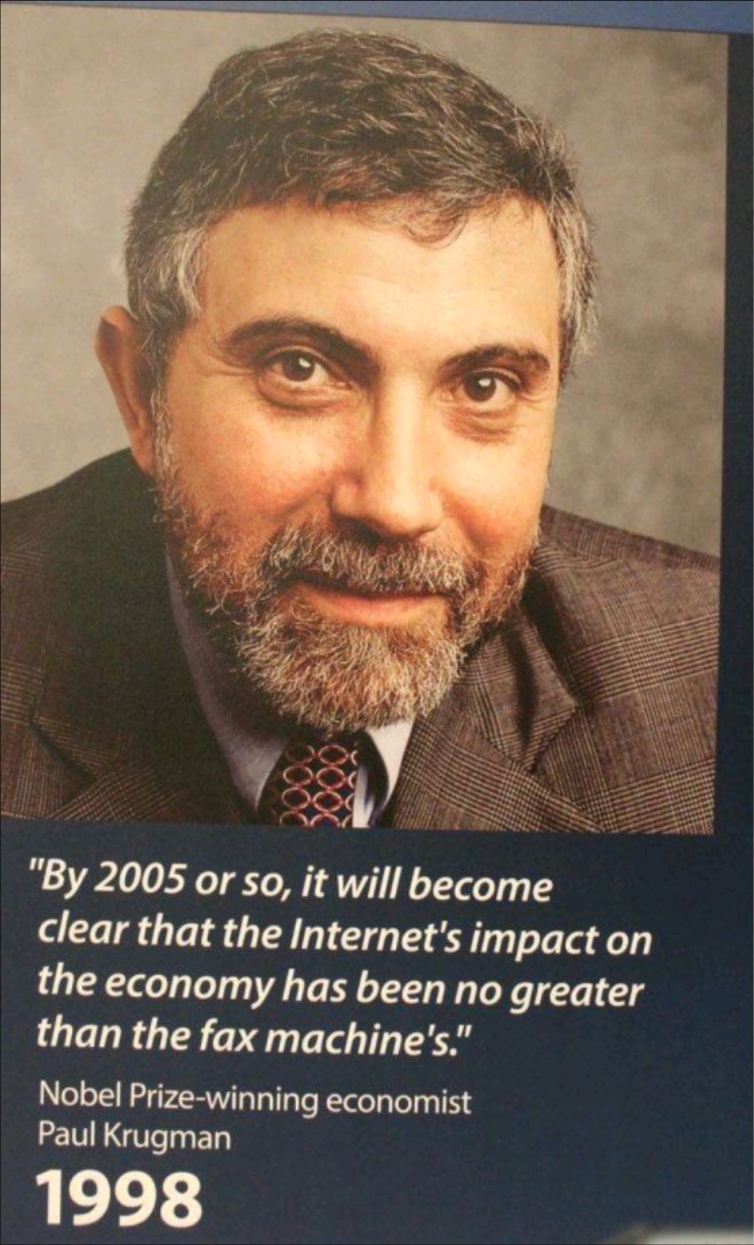
Whilst it’s all good and fun to laugh at comments like that now, there are economists who do think that AI productivity gains will be rather modest. I very much sit on the opposite side of that spectrum.
Back in 2022-23, I often thought that there would be potential in the growth of AI to result in another dot-com style boom to economic growth. The difference being of course, that this time around it would be much more centred around the US with less growth occuring across the rest of the world, given the dominance of American labs.
After all, the US consumer is one of the most dominant forces in the modern world. When capacity expands and a single company of a dozen employees is able to service that bloc, why do you need the rest of the world? Where, for instance, is the incentive to establish a call centre in Manila or a bank reconciliation team in Mumbai when a collection of AI agents can perform much of the same work from a nearby data centre?
This doesn’t mean the ex-US world is irrelevant, firms still need access to international customers, oil, iron ore and shipping routes. What is going to be less important though is labour arbitrage to the lowest bidder.
Unemployment and Deficits
That however is not why I’m writing this post. I’m more interested in the development of the labour market in the age of AI and robotics.
Historically employers would hire an employee, that employee would trade their time and energy for money, and the employer would sell or use whatever that employee produced. When that employee can be replaced with some matrix math, weights and a GPU, why keep them employed. So the employee leaves and tries to find a new job, discovering that a great portion of jobs now have done the same. This will result in an enormous amount of disruption to developed economy labor markets, structural unemployment will rise and run the risk of turning into long term unemployment.
In countries like Australia or NZ, which are not reaping the benefits of having indigenous labs, the risk is far greater. Naturally the solution (whether said explicitly or otherwise) will be to expand the public service and welfare. We’ve already seen this happening in Australia with programs like the NDIS.
At a certain point though this becomes untennable; deficits baloon, house prices get crushed, inflation rises and civil unrest ensues. Governments will seek to raise taxes in an effort to fund these expansions, but this will only serve as a stop-gap.
The UK for example, pays out more in welfare (£333 billion) than it collects in income taxes (£331 billion).
It’s not a sustainable situation, but politicians are disinterested in cutting spending. It’s far, far easier to win an election by taxing than saving (or growing).
Which leaves the question; how will work look in the future, when potentially millions are unemployed and the government can’t afford to step in?
The Demand for Responsibility
I believe that the demand for ‘responsibility’ will rise drastically. The value in a good portion of employees will no longer be their time, effort or expertise, but rather their willingness to have responsibility.
It can be hard to get a grasp on what I mean, so let’s talk about Waymo. Normalising for distance driven, they’re one of the safest ways to get around on the road, almost by a factor of 10. Yet people keep pushing back against them. They don’t like the idea of some clanker driving them from A to B, with no human to bear the brunt if a crash happens.
The reason is simple, the average person does not feel safe trusting a computer. Even if we point out how much safer said computer is, the regular person is not willing to accept that when something goes wrong, there is not someone’s head to chop off. Saying “shit happens” just doesn’t provide closure when a death occurs.
The average person doesn’t want a system that performs well, they want recourse when said system fails.
This creates a category of work that can never be replicated with AI, not because AI is useless, but because you can’t put a model in gaol, and you can’t cross-examine an LLM. The driving force behind this will naturally be governments and legislation, if you want to use AI in a call centre, you will be beholden to whatever that AI tells a customer. Resulting in that company being forced to have some sort of human sitting there performing oversight of chats.
Someone must sign the audit.
Someone must approve the loan.
Someone must sign off on that the bridge being safe.
And someone must prescribe the medicine.
A human will ultimately need to sit in the middle and accept the legal risk that comes with providing a service or product to consumers. In each of these cases, odds are that an LLM will basically do all of the heavy lifting, the drafting, the calculating, the talking. But the final decision carries legal consequences. Society therefore requires an identifiable person or institution that can be licensed, regulated, sued, removed or punished.
This is the economics of responsibility.
The ‘Human Responsibility Wrapper’
We’ve all seen a million SaaS GPT-wrappers by now, but what may come is a drastically different looking labour market where most service jobs become a ‘liability wrapper’. Most professions may become hollowed out in the middle. A law firm may need fewer junior associates to review documents and draft contracts, while retaining partners who provide advice and carry professional liability, for instance.
The person involved effectively becomes a wrapper around the production of an LLM.